
Brantley Projected and Actual Release
A projected date is an estimate or scheduled point based on the sentence and current records. An actual release date records the event after custody ends or changes. The gap matters because Brantley’s InterOp roster is a current-booking list, not a future-release calendar. A person awaiting court at Brantley County Jail normally has no GDC projected date. Bond, a judge’s order, case disposition, another agency hold, or transfer can control the next event.
A locally sentenced person may have a completion date held by the jail or sentencing court. It was not published in the public roster. A Georgia state prisoner belongs in GDC and Parole Board systems. Those records may use projected-release concepts or Tentative Parole Month, but neither is a guaranteed community release.
Find a Brantley Projected Release Date
Start by separating county, state, and federal custody. The same person may pass through more than one system. A drop from the local roster can mark bond or sentence completion, but it can also mark a GDC transfer.
- Check the Brantley current roster only to see whether the person is still marked currently booked.
- For a local case, review the Brantley court record for bond, sentence, and disposition, then ask jail records for the existing calculation.
- For a state sentence, search GDC Find an Offender by name, ID or case number, age, and other details.
- Use the Parole Board TPM information and lookup for parole timing.
- Confirm a reported release with the agency that held the person.
Federal prisoners use BOP. Immigration custody uses ICE only when documented. Neither is a routine Brantley jail date source. The Brantley release records path helps trace an unclear destination.
Georgia Credits Change Brantley Dates
The GDC Performance Incentive Credit program can reduce length of stay for eligible state offenders who make satisfactory progress in education, vocational work, treatment, work assignments, and conduct. The fact sheet says the Parole Board determines eligibility, one point equals one month of credit, and an eligible offender can accumulate up to twelve months. It lists exclusions that include a death sentence, life sentence, a sentence of two years or less, and a non-parole-eligible offense.
PIC does not create a safe do-it-yourself calculator. Eligibility, earned points, conduct, program completion, sentence structure, and Board decisions matter. The Brantley jail roster does not display PIC because this is a state-prison framework. Ask the jail and court about a local sentence.
Georgia also has no single universal rule that every person serves the same fixed percentage. Board guidelines weigh severity and risk and may recommend months or a percentage, but the Board may accept or reject that recommendation. Serious violent felony and life rules vary by offense date and sentence type.
Why Brantley Release Dates Change
A date changes when the legal basis, credits, custody destination, or agency decision changes. Online lag can also make an unchanged legal date look different.
| Event | County effect | State effect |
|---|---|---|
| Bond | Release or continued custody | Usually tied only to new charges |
| Court order | Release, time served, or another sentence | Shapes the prison term |
| GDC transfer | Ends local placement, not custody | Makes state tools primary |
| Detainer | May block community release | Can alter release logistics |
| PIC credit | Not a roster field | May reduce eligible state stay |
| Conduct or programs | No projected public field found | May affect credit or TPM |
| Residence plan | Not a local calculation | Must be acceptable for parole |
| Data lag | Roster may trail processing | GDC or VINE may trail action |
A detainer is a basis for another authority to keep custody. Ask “released from which custody?” when records conflict.
Confirm Brantley Release Timing
Use the office that created the date. Brantley jail records and the court control county facts. GDC and the Parole Board control state timing. DCS Waycross handles field supervision after state felony release. A VINE alert can provide notice, but it is not the legal release record.
Georgia VINE offers app, phone, email, text, and TTY notices where the person and agency are included. Register on the specific record and save any confirmation detail. The Brantley County VINELink check explains the alert flow.
If two dates differ, record each label. A sentence end, TPM, projected notice, eligibility point, and actual release answer different questions.
Written verification is useful after a transfer. Ask the Brantley jail for the local transfer event and GDC for the state custody record. Both dates may be right because they describe separate stages. A court order can bridge them by showing the sentence or transfer authority. Keep the booking number, case number, and GDC identifier separate so staff can locate the correct record.
After release onto parole, the Parolee Search and DCS Waycross office become more useful than an inmate timing page. After sentence expiration, a discharge record may be the right proof. If the person remains in pretrial custody, state parole calculations cannot supply a date the court has not set.
Brantley TPM Is Not Release
Georgia’s public parole timing term is Tentative Parole Month. The Board says a TPM marks when it plans final review and may set a parole release date. Good conduct and required program completion can affect it. A TPM is a planning point, not a promise that release will happen that month.
The Board can deny parole, reconsider a case, require an acceptable residence plan, or change a decision before release. Life-sentence cases follow distinct eligibility rules. The Parole Process page reports different serious-violent-felony life eligibility periods based on offense date.
The official GDC PIC page is shown below because earned credit is one Georgia-specific reason a state stay may change.
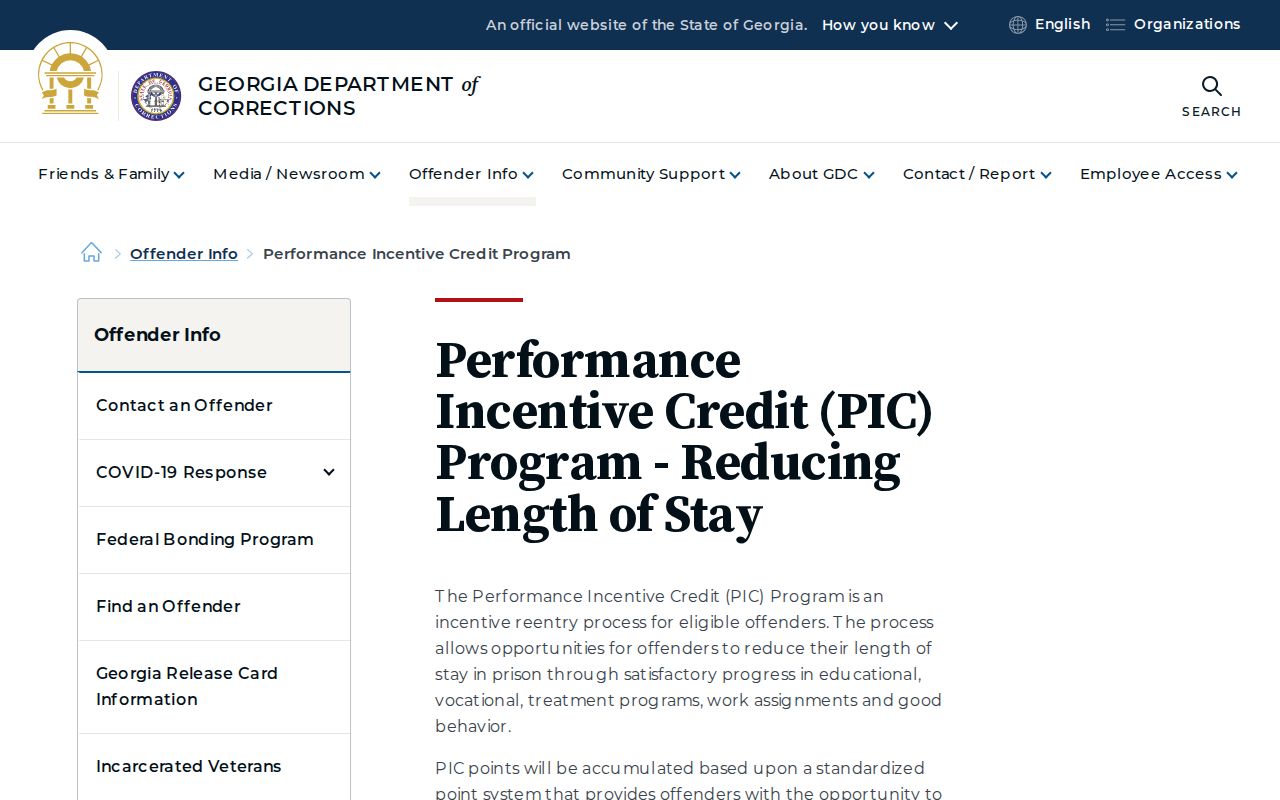
The state page documents the program framework, while GDC and the Parole Board retain the individual calculation.
Georgia Projected Release Notice
O.C.G.A. § 42-5-9 recognizes projected dates in the GDC system. It requires at least fifteen days’ notice before projected release under GDC authority, including public website notice to district attorneys and law enforcement and notice to judges and victims in specified cases.
This law does not create a public countdown for each Brantley jail detainee. It applies to GDC authority. A pretrial local detainee still depends on bond, court action, holds, or transfer.
Use the statute to understand state notice, not to calculate a person’s date. The current agency record, sentence, credits, and legal decisions remain essential.
Note: A Georgia projected notice and a TPM do not prove that actual release occurred.
Brantley Date Records by Custody
A county booking, local sentence, state sentence, parole review, and federal sentence produce different date records. For a pretrial Brantley detainee, bond can be set, changed, denied, or paid. A later court order can dismiss charges, impose time served, or require release. Another hold can still prevent community release. The current roster reports custody and arrest facts, but the research found no public projected-date field.
For a local sentence, ask the jail and sentencing court for the existing calculation. Include the person’s full name, arrest date, charge, warrant number, court, case number, and booking number when known. Georgia open-records rules do not require an agency to make a new report. A narrow request for an existing sentence-completion or release field is more precise than asking staff to predict what a judge or another agency will do.
For GDC custody, the offender search establishes state identity and status. The TPM lookup accepts a six-digit inmate number, GDC ID, or personal data. The Board may grant, deny, reconsider, or withdraw parole before the effective date. A residence plan can also affect actual release. These decision points explain why the public planning month can differ from the final event.
For a federal prisoner, BOP is the date source. A past release date and no facility can show that BOP custody ended. ICE is limited to immigration custody. Neither federal route supplies a missing Brantley county-jail calculation.
After release, use the record that proves the completed event. A jail release entry, court disposition, GDC discharge status, parole record, or BOP result can each be right within its own scope. Do not collapse several stages into one date. A transfer from Brantley to GDC, a later parole date, and a final supervision discharge can all occur in the same case.
When Brantley Has No Fixed Date
A pretrial detainee may wait on bond, first appearance, a later hearing, case disposition, or another agency hold. None supplies a stable projected date until an authority acts. The roster’s arrest date and days-in-jail figure describe time already spent. They do not forecast release. Even a total bond field does not prove that payment has occurred or that all holds are cleared.
Ask the court about its order and the jail about actual processing. If bond changes, the docket may show the judicial action while the jail records when custody ended. If charges are resolved as time served, both the sentence and release entry matter. If a detainer applies, the local case can end while the person remains held for another authority.
A sentenced state prisoner presents a different problem. GDC sentence data, PIC eligibility, parole guidelines, TPM review, conduct, programs, residence planning, and holds can all affect timing. The official agencies should calculate the result. A public user can identify the relevant fields and verify changes, but should not turn a point total or percentage into an asserted exact date.
Keep county and state identifiers with each request. A Brantley booking number locates the local stay, a court case number locates the sentence, and a GDC number locates state custody. Matching those records in sequence explains dates far better than searching one name across unrelated systems.
Verify Brantley Date Changes
When two official systems show different dates, first identify what each date measures. The Brantley jail arrest date begins a local booking, while days in jail is only a current-custody count. A court date concerns the case. A GDC projected date concerns a state sentence, and a Tentative Parole Month concerns possible parole review. None can be substituted for the actual date and time that a person left a facility.
Keep the person's GDC ID, booking identifier, court case number, and the date each source was checked. Then ask the agency responsible for the disputed field to verify it. The sheriff or jail confirms local release, the clerk confirms the order or sentence, GDC confirms state corrections data, and the Parole Board confirms its own parole information. This record-by-record check is more reliable than choosing the earliest date shown.